.

Showing posts with label winter. Show all posts
Showing posts with label winter. Show all posts
Forcing Blooms in Winter
Forcing blooms in winter.
I think each year I won't bother with amaryllis and other flowers forced into winter bloom. After all, I've grown them in the past, I know what they look like, so why grow them again?
Why grow them again? If you think that's an actual question, then you aren't an actual gardener and you can just mosey right along now to some other website about "plastic flowers are

Winter: We are going to need...
We are going to need some supplies. Seed catalogs, gardening books, houseplants, and a stack of gardening magazines. That stack of gardening magazines that piled up while we were out in the garden all summer will do nicely.
We are going to need a good memory. Garden pictures, old blog posts, and garden journal notes.
We are going to need something to keep us warm. Blankets, a fire in the
We are going to need a good memory. Garden pictures, old blog posts, and garden journal notes.
We are going to need something to keep us warm. Blankets, a fire in the
The Fascinating Christmas Rose: Helleborus niger
Helleborus niger 'Josef Lemper'
I have scoured the garden literature of the 20th and 21st centuries to bring forth for the holidays some tidbits about Helleborus niger, the Christmas Rose. I did this realizing that it might possibly lead me down one or two or more rabbit holes where securing the keys to escape might involving purchasing a few more old gardening books.
This did indeed turn
The Holly and the Ivy
Or to give them their proper names - The Ilex and the Hedera - doesn't quite have the same ring to it does it? No need for the 3 minute warning either, I'm not about to burst into verse. Being tone deaf I would not wish me singing a verse or two on my worse enemy!! I know my limits!!
There are probably umpteen thousand websites/blogs out there, which reference these British Garden stalwarts and for that reason I'm not going to go into detail except to profile what grows in my garden.
However, should curiosity get the better of you, more information can be gleaned from British Woodland Trust or RSPB. Alternatively a google search of either Holly or Ivy will glean you more information than you could probably handle in one browsing session.
The Holly.....
 Ilex aquifolium 'J C Van Tol' (AGM) grows in my garden as a rather useful evergreen hedge. Planted by previous owners many years before I took over. Up until this earlier this year it received a twice yearly 'tidy up' - however, having finally put a name to the face - it was given a gently shear in springtime. Pruning group of this shrub is Pruning Group 1 (little or no pruning). Extremely hardy and would quite happily reach a height of around 6m if left to it's own devices - it's eventual spread being half of it's height.
Presently kept to a height of around 1.8m (6ft in old money) primarily for pruning purposes, this height also reflects the height of the fencing which surrounds the remainder of the garden. As well as this green variety Van Tol Hollies also come in variegated forms with gold and silver leaf margins. This hedge also provides cover/protection for the many birds which visit the garden. At one time Robins used to nest in it's depths, this is sadly, no longer the case. My 3 cats used the hedge for climbing practice when they were kittens, this I'm sad to say caused them up nest and leave!
 Unlike most other holly the leaves of J C Van Tol are oval
to elliptical shaped and almost spineless. A great big plus as
far as I'm concerned! These glossy leaves certainly do not have the 'ouch' factor! Being evergreen these trees/shrubs does not lose its leaves in winter but will, like other evergreens, drop leaves throughout the year. For those who like making up Christmas Wreaths - the spineless leaves make it a great choice.
Shade toterant and considered one of the best hollies for growing as a 'standard'.


Flowering time for this plant is spring and summer - it produces tiny 4 petal white flowers, which I supposed is considered as insignificant in plant terms. J C Van Tol is self fertile, therefore removes the need of planting both male and female plants in order that berries are produced.
These berries are abundant in Autumn and Winter, it should be noted that these berries, if eaten, will cause stomach discomfort if ingested. That being said, it should also be noted that they are an extremely important food source for birds and wildlife at the time of the year other food is scare. The dark green leaves and the bright red foliage extend the season of interest in the garden - making it an all year round worthwhile plant!!
Next comes the Ivy.......
Hedera helix (Common/Englis Ivy) is often considered a thug in many gardens, indeed, considered an invasive species in many areas. I have a vast expanse of new fencing to cover in my garden, along with Camellia and Pyracantha I have planted 2 ivies this year. It is my opinion that no garden (depending on planting schemes) can really be without Ivy. I'm hoping that with pruning they should not become a problem. Oh, and I'm not afraid of a bit of hard work should pruning alone not suffice!!
Ivy is considered extremely important for wildlife. This woody evergreen climber will clamber up trees, walls and fences. It also has the ability of being able to grow as ground cover - prefers shade and important to note that only shoots receiving sun will flower. Many insects and birds will use this for shelter and protection. The nectar from its flowers provides nourishment for many bees, hoverflies, butterflies and other late-flying insects just before hiberation time.
As yet, my Ivies are very small and insignificant but thought this would be a useful place to log their quite different leaves
 Hedera helix 'Goldheart' - I don't think that name needs any explaination!! Slow to get established apparently. As I want it to grow up and cover a fence, I have provided it with support in the way of a clematis net and a few strategically placed garden canes until it it able to support itself.
Ivy is self clinging and uses ariel rootlets to attach itself to its host.
The contrast in the leaf colour is a deep green with a bright yellow centre. It will take on a tinge of pink in colder weather (as seen here). Beautiful red stems add further to the colour provided by this plant. As it matures - it's leaves will become larger and make much more of a statement. Currently growing in part shade where 2 previously planted clematis failed - I'm hoping that it will receive just enough sun to produce it's very nectar rich flowers.
 The other Ivy I have planted in the ground is an unknown variety. Bought in mid 2011 to be used as part of an autumn/winter display container but had began to look rather shabby by the time summer 2012 came around as I had kind of neglected it. It has thrived since it got it's feet in the ground and is currently using a carefully place Silver Birch log to scramble over then up onto the very tall closed board fence panel that had to be put in as part of my planning application to have my kitchen extended.This area I suppose could be considered as semi-woodland, still in it's infancy with a couple of decideous shrubs (Acer and Magnolia) surrounded by ferns, hostas, epimedium, primula and a rather special little Dicentra. Plain green with silver veining - it should provide an ideal foil for it's neighbours.
The other Ivies growing in the garden are currently being utilised in containers providing a bit of colour on the steps outside the back door. Whether or not these make it into the garden, only time will tell.


This dark green, almost grey Ivy, presently tumbling over another winter container. Choisya Sundance is it's chosen foil - together with Galtheria, Skimmia and dwarf bulbs should make a stunning display come springtime.
There are probably umpteen thousand websites/blogs out there, which reference these British Garden stalwarts and for that reason I'm not going to go into detail except to profile what grows in my garden.
However, should curiosity get the better of you, more information can be gleaned from British Woodland Trust or RSPB. Alternatively a google search of either Holly or Ivy will glean you more information than you could probably handle in one browsing session.
The Holly.....
 Ilex aquifolium 'J C Van Tol' (AGM) grows in my garden as a rather useful evergreen hedge. Planted by previous owners many years before I took over. Up until this earlier this year it received a twice yearly 'tidy up' - however, having finally put a name to the face - it was given a gently shear in springtime. Pruning group of this shrub is Pruning Group 1 (little or no pruning). Extremely hardy and would quite happily reach a height of around 6m if left to it's own devices - it's eventual spread being half of it's height.
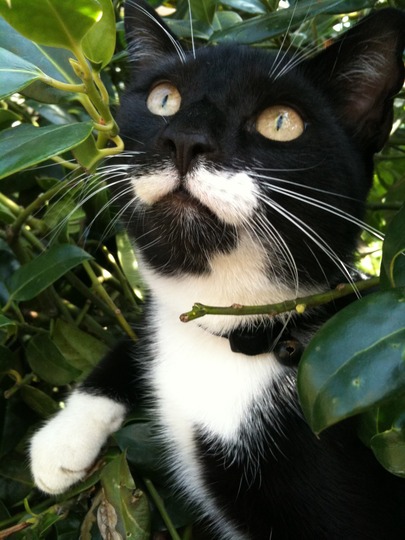 |
| Kooki, as a kitten, honing his climbing skills |

to elliptical shaped and almost spineless. A great big plus as
far as I'm concerned! These glossy leaves certainly do not have the 'ouch' factor! Being evergreen these trees/shrubs does not lose its leaves in winter but will, like other evergreens, drop leaves throughout the year. For those who like making up Christmas Wreaths - the spineless leaves make it a great choice.
Shade toterant and considered one of the best hollies for growing as a 'standard'.


Flowering time for this plant is spring and summer - it produces tiny 4 petal white flowers, which I supposed is considered as insignificant in plant terms. J C Van Tol is self fertile, therefore removes the need of planting both male and female plants in order that berries are produced.
These berries are abundant in Autumn and Winter, it should be noted that these berries, if eaten, will cause stomach discomfort if ingested. That being said, it should also be noted that they are an extremely important food source for birds and wildlife at the time of the year other food is scare. The dark green leaves and the bright red foliage extend the season of interest in the garden - making it an all year round worthwhile plant!!
Next comes the Ivy.......
Hedera helix (Common/Englis Ivy) is often considered a thug in many gardens, indeed, considered an invasive species in many areas. I have a vast expanse of new fencing to cover in my garden, along with Camellia and Pyracantha I have planted 2 ivies this year. It is my opinion that no garden (depending on planting schemes) can really be without Ivy. I'm hoping that with pruning they should not become a problem. Oh, and I'm not afraid of a bit of hard work should pruning alone not suffice!!
Ivy is considered extremely important for wildlife. This woody evergreen climber will clamber up trees, walls and fences. It also has the ability of being able to grow as ground cover - prefers shade and important to note that only shoots receiving sun will flower. Many insects and birds will use this for shelter and protection. The nectar from its flowers provides nourishment for many bees, hoverflies, butterflies and other late-flying insects just before hiberation time.
As yet, my Ivies are very small and insignificant but thought this would be a useful place to log their quite different leaves

Ivy is self clinging and uses ariel rootlets to attach itself to its host.
The contrast in the leaf colour is a deep green with a bright yellow centre. It will take on a tinge of pink in colder weather (as seen here). Beautiful red stems add further to the colour provided by this plant. As it matures - it's leaves will become larger and make much more of a statement. Currently growing in part shade where 2 previously planted clematis failed - I'm hoping that it will receive just enough sun to produce it's very nectar rich flowers.
 The other Ivy I have planted in the ground is an unknown variety. Bought in mid 2011 to be used as part of an autumn/winter display container but had began to look rather shabby by the time summer 2012 came around as I had kind of neglected it. It has thrived since it got it's feet in the ground and is currently using a carefully place Silver Birch log to scramble over then up onto the very tall closed board fence panel that had to be put in as part of my planning application to have my kitchen extended.This area I suppose could be considered as semi-woodland, still in it's infancy with a couple of decideous shrubs (Acer and Magnolia) surrounded by ferns, hostas, epimedium, primula and a rather special little Dicentra. Plain green with silver veining - it should provide an ideal foil for it's neighbours.
Sold as part of a 'bedding tray' whether this is hardy or not only time will tell. It seems happy enough for now with companions of Cypressus Goldcrest, heuchera, galtheria and dwarf bulbs.

This dark green, almost grey Ivy, presently tumbling over another winter container. Choisya Sundance is it's chosen foil - together with Galtheria, Skimmia and dwarf bulbs should make a stunning display come springtime.
As I strive to make my garden more wildlife friendly and provide as many different habitats to encourage more visitors - both these plant will be invaluable and dependable in my quest and I'm pleased you could join me on my journey!
"The best gardeners are the greatest readers"
Helleborus niger 'Josef Lemper' bud
Early this morning, before it was even light out, I found my copy of Gardens in Winter by Elizabeth Lawrence (1961) for the sole purpose of looking up information on the Christmas Rose, Helleborus niger.
I like to look up information in books as a change of pace from the "fast food" information that is often what you get when you do an online search.
I
First Snow Starts the Thinking Season of Gardening
First snow. Thursday night into Friday morning. About four inches here, give or take. Plus it is quite chilly.
No one is going to sit in those chairs for a while now. They are made of engineered wood and will withstand the wintry weather, so I leave them out in the garden.
They are too heavy for me to move around every fall and spring, anyway.
I'm not much of a winter vegetable gardener,
How Do You Know That It Is Finally Wintertime?
How you know that it is finally wintertime in your garden?
It is 13 degrees Fahrenheit outside.
Is it when you no longer hear the sounds of the cicadas in the trees?
It is 13 degrees Fahrenheit outside.
Is it when you've raked just enough leaves so that the neighbors are not annoyed that your leaves keep blowing into their yard?
It is 13 degrees Fahrenheit outside.
Is it when a
It is 13 degrees Fahrenheit outside.
Is it when you no longer hear the sounds of the cicadas in the trees?
It is 13 degrees Fahrenheit outside.
Is it when you've raked just enough leaves so that the neighbors are not annoyed that your leaves keep blowing into their yard?
It is 13 degrees Fahrenheit outside.
Is it when a
Log Bird Feeder
There truly is very little gardening to be done - we've had frost for almost 2 weeks and the snow came just as predicted by those weather forecasters (makes a change). I must admit that I get rather guilty when I'm unable to do any gardening - I don't even need much convincing to get out there and clear up the winter debris from those unwanted places.
As part of my 'gardening fix' I decided to have a go at making a Bird Feeder - I came across a picture of a recycled log feeder recently and thought that I could very easily fashion something from a log I rescued from a pile going to the council tip after a neighbour had 2 very dead conifers removed from her garden back in summer. For the past few months I've walked by it as it lay on the path - yet to be given a purpose. Well it needn't wait any longer.
Here is the log with screw in vine eye at either end. These need to be spaced appropriately as they will provide the balance needed for hanging....

It will be necessary to drill a pilot hole first - I find the easiest way of screwing these in is to use a pair of pliers. An alternative would be to drill a whole through the entire width, slip rope through and tie a large knot on the underside. I did give this some consideration but decided that the wet weather would probably make the rope perish quicker.


Whilst persevering using the spade bit - I suddenly remembered that I had bought a set of core cutting bits years ago - but the question was WHERE WERE THEY??????????? An hours or so later I found them in an old tool box way at the back of the shed. Note to self - sort out that shed in spring!!!!!


Idealy, I would have preferred to hang my feeder from a stong branch of a mature tree - but seeing as there is none in my garden, I opted to hang it on the fence directly outside my kitchen window. This would also allow us watch the birds as they feed.
A couple of redundant brackets used for hanging planting baskets were attached to the fence - make sure that what ever you hang your feeder from it is strong enough to take the weight. I attached it through the faceboard and into the arris rail behind with good sized screws. A couple of lengths of chain (left over from another project) was used as a means to hang it from the brackets.

I hope you find this inspirational and are tempted to have a go yourself. Please let me know!!


As part of my 'gardening fix' I decided to have a go at making a Bird Feeder - I came across a picture of a recycled log feeder recently and thought that I could very easily fashion something from a log I rescued from a pile going to the council tip after a neighbour had 2 very dead conifers removed from her garden back in summer. For the past few months I've walked by it as it lay on the path - yet to be given a purpose. Well it needn't wait any longer.
Here is the log with screw in vine eye at either end. These need to be spaced appropriately as they will provide the balance needed for hanging....

It will be necessary to drill a pilot hole first - I find the easiest way of screwing these in is to use a pair of pliers. An alternative would be to drill a whole through the entire width, slip rope through and tie a large knot on the underside. I did give this some consideration but decided that the wet weather would probably make the rope perish quicker.

In order to provide a supply of food for the birds you will need to create hollows along the length of the log. I started doing this by using the largest size spade bit I had but found it wasn't doing the job to my nor Robbie Robin's satisfaction.

Whilst persevering using the spade bit - I suddenly remembered that I had bought a set of core cutting bits years ago - but the question was WHERE WERE THEY??????????? An hours or so later I found them in an old tool box way at the back of the shed. Note to self - sort out that shed in spring!!!!!
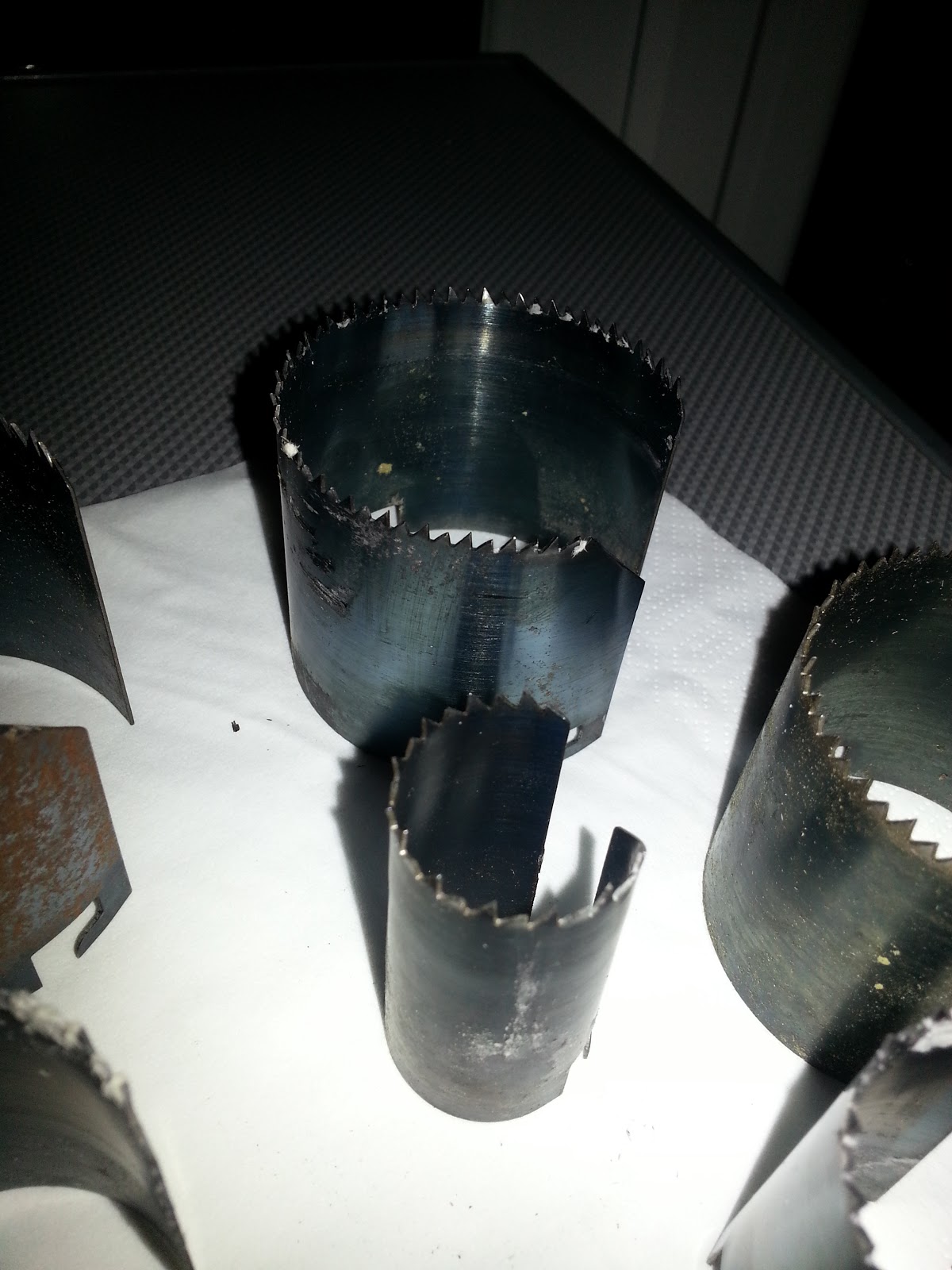
As you can see in the picture below - this made the work much easier. The down side to using a hole cutter is that it does not remove the centre. However a mallet and a chisel soon has them out. It is best to try smooth out the bottom of the hole as much as possible.

There we have it - the log with it's many varying sized holes. I also gave consideration to drilling a smaller hole all the way through but decided that not having a wooden drill bit long and thin enough to go through the whole way - the expense of buying one wasn't worth it - as a new log would be free if it rots. Cleaning should not be a problem either as I already use small bottle brushes for cleaning out other feeders - the same could be done with this.

Idealy, I would have preferred to hang my feeder from a stong branch of a mature tree - but seeing as there is none in my garden, I opted to hang it on the fence directly outside my kitchen window. This would also allow us watch the birds as they feed.
A couple of redundant brackets used for hanging planting baskets were attached to the fence - make sure that what ever you hang your feeder from it is strong enough to take the weight. I attached it through the faceboard and into the arris rail behind with good sized screws. A couple of lengths of chain (left over from another project) was used as a means to hang it from the brackets.

All that was left to do now was to fill it with feed and wait - rather strangely for the birds that visit my garden it took them a whole entire day before they began to investigate what goodies were on offer.
The selection of goodies on offer is rolled oats suet pellets, sunflower hearts, mealworm, grated cheese and dried fruit. The birds seemed to like it - which after all was the main purpose of doing this.
I didn't use seeds as I don't want an excess of weeds in the border below!
A few other thoughts:
- could just as easy be hung vertically - thought would need to be given to the food falling out. Using lard or peanut butter as a way of solidifying the food could be an option
- could also be used on the ground - no hanging required
- make sure feeder is accessible for refilling
- easy to remove for cleaning
- choose size of log carefully - the larger the log - the heavier it will be
- the nature of the log means that it will rot over time
- not so accessible for cats
- would be useful to hang on the inside of a balcony if you don't have a garden


Obligatory First Snowfall Post
Indianapolis, IN: It's snowing today, which means I feel a certain obligation to post some pictures of snow scenes in my garden.
If you live where the sun is shining and you can skip about your garden in summer clothes today, you might want to get a blanket to wrap up in before continuing to read this post. Just the mere viewing of these pictures of snow scenes could cause your internal body
Dear Garden in Winter
Dear Garden,
Dearest Garden,
Dear Garden in Winter,
I am entrusting to your care these little plants that I was not able to find just the right homes for before it got cold, so I planted them out in their pots up next to the house in an area that is somewhat protected.
These include a mix of plants I bought and some that were sent to me to try out. I hope you will take good care of them.
Dearest Garden,
Dear Garden in Winter,
I am entrusting to your care these little plants that I was not able to find just the right homes for before it got cold, so I planted them out in their pots up next to the house in an area that is somewhat protected.
These include a mix of plants I bought and some that were sent to me to try out. I hope you will take good care of them.
On a spring-like December day
Viola blooming in the winter lawn.
On a spring-like December day, when the high temperature was 63F, you can't blame a gardener for chucking all other plans - plans for Christmas shopping, tree decorating, caroling, wassailing, egg nogging, decking the halls, addressing Christmas cards and writing her letter to Santa Claus and the Christmas Cottontail - so she could head out to the garden for
December
It's December. The squirrel knows it. The calendar shows it.
Many of us will pause as we flip our calendar over to this last month of the year and wonder how it came to be that another year has nearly passed.
We'll think of the plans we made for our gardens at the beginning of the year, and wonder what became of those plans, if we can even remember them.
We may have started the year with
Many of us will pause as we flip our calendar over to this last month of the year and wonder how it came to be that another year has nearly passed.
We'll think of the plans we made for our gardens at the beginning of the year, and wonder what became of those plans, if we can even remember them.
We may have started the year with
'Twas a month before winter
'Twas a month before winter... well, actually it is 26 days until true winter which begins on December 21st.
The only blooms left are in the sun room. I'm currently enjoying these orange, orange, orange Thanksgiving cactus blooms.
I have separated them from some hot pink Thanksgiving cactus blooms because even someone as color-challenged as I sometimes am can see that these clash.
Out
My garden has never been more ready for winter
Columbine seedlings in the leaves
Elizabeth Lawrence, the famous southern garden writer, had one for her garden.
So did the writer, Eudora Welty, who spent a lot of time in her garden, fussing over her camellias. She wrote in her gardening letters during World War II it was hard to find a reliable one.
I never thought I'd have one, but I do.
Yes, I have a guy I call to come out and help in
Stowed Away For Winter
We northern gardeners do something that southern gardeners don’t do.
We put it all away.
Containers, pots, furniture, decorations, hoses… to have them last more than a season or two, we must put them away each fall, or at least stow them somewhere safe where they won’t get pelted with sleet or covered by snow.
Otherwise, winter would destroy it all.
In fact, figuring out where we would
We put it all away.
Containers, pots, furniture, decorations, hoses… to have them last more than a season or two, we must put them away each fall, or at least stow them somewhere safe where they won’t get pelted with sleet or covered by snow.
Otherwise, winter would destroy it all.
In fact, figuring out where we would
Let it Snow - A Troy-Bilt Sponsored Snow Thrower Giveaway!
I remember snow.
White, soft, glistening in the sunlight like diamond dust.
Serene, silent, muffling the sounds of the garden.
It covers the garden, hiding it, blanketing it with comforting insulation. It reveals the faint foot prints of rabbits, the scratch of the birds huddled under a spruce tree, the trail of a gardener walking about for no reason in particular, except to see the beauty
White, soft, glistening in the sunlight like diamond dust.
Serene, silent, muffling the sounds of the garden.
It covers the garden, hiding it, blanketing it with comforting insulation. It reveals the faint foot prints of rabbits, the scratch of the birds huddled under a spruce tree, the trail of a gardener walking about for no reason in particular, except to see the beauty
A gardener's winter lair
One of the most important preparations a gardener can make for winter is to set up a winter lair.
The winter lair should be indoors for obvious reasons, like snow and sleet and ice and rain and cold winds that knock the breath out of you.
It should be comfortable and if at all possible situated so that the gardener can see out into the garden from the lair.
I've never set up such a spot for
The winter lair should be indoors for obvious reasons, like snow and sleet and ice and rain and cold winds that knock the breath out of you.
It should be comfortable and if at all possible situated so that the gardener can see out into the garden from the lair.
I've never set up such a spot for
To pot or not to pot?
I'm in need of a wee bit guidance - can you help?
I took some cuttings of my gorgeous Salvia Amistad back in mid October, as was suggested by a few of you when I raised my concern re getting it through winter. I rooted some in water and also the more conventional way in compost. The ones in water rooted rather quickly (50% success rate) and were potted up into individual pots 2 weeks ago. Those that have successfully rooted in the compost took a bit longer but are now showing signs that they have rooted. Tiny roots are now appearing from the holes in the base of the pot.
This is where I get stuck! Do they need individual pots now or will they happily survive in the same pot for winter? - and - At what point to I nip them out to make them bushier?
These are my first attempts at taking cuttings so am quite excited that I've had some success. Any advice greatly appreciate. Thanks.
 |
| rooted Salvia cuttings November 2014 |
This is where I get stuck! Do they need individual pots now or will they happily survive in the same pot for winter? - and - At what point to I nip them out to make them bushier?
These are my first attempts at taking cuttings so am quite excited that I've had some success. Any advice greatly appreciate. Thanks.
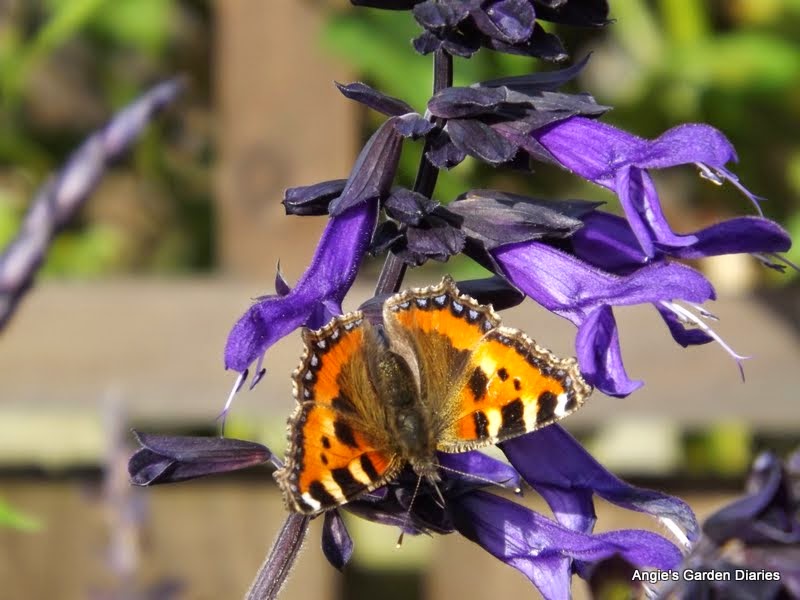 |
| Salvia Amistad and Small Tortoiseshell Butterfly |
In Other News... Winter Continues
Winter continues here at May Dreams Gardens.
The good news is that my Christmas cactus, which bloomed several weeks ago, provided me with a few bonus flowers this week.
It's funny, but I don't usually have orange flowers outside in my garden, except for a few ditch lilies that I have planted on the side of the house.
I planted the ditch lilies simply because someone gave them to me and they
The good news is that my Christmas cactus, which bloomed several weeks ago, provided me with a few bonus flowers this week.
It's funny, but I don't usually have orange flowers outside in my garden, except for a few ditch lilies that I have planted on the side of the house.
I planted the ditch lilies simply because someone gave them to me and they
Garden fairies provide an update on winter
First Snowdrop, January 24, 2015
Garden fairies here.
We are garden fairies and we have been watching this blog wondering if anyone was going to post anything and we didn't see anyone posting anything, so we decided, once again, to take matters into our own hands and post something.
We have decided to provide an official winter update on the goings on around here.
One of the goings on