
There are probably umpteen thousand websites/blogs out there, which reference these British Garden stalwarts and for that reason I'm not going to go into detail except to profile what grows in my garden.
However, should curiosity get the better of you, more information can be gleaned from British Woodland Trust or RSPB. Alternatively a google search of either Holly or Ivy will glean you more information than you could probably handle in one browsing session.
The Holly.....
 Ilex aquifolium 'J C Van Tol' (AGM) grows in my garden as a rather useful evergreen hedge. Planted by previous owners many years before I took over. Up until this earlier this year it received a twice yearly 'tidy up' - however, having finally put a name to the face - it was given a gently shear in springtime. Pruning group of this shrub is Pruning Group 1 (little or no pruning). Extremely hardy and would quite happily reach a height of around 6m if left to it's own devices - it's eventual spread being half of it's height.
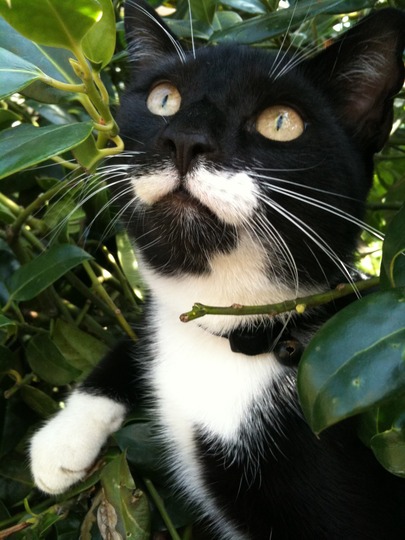 |
| Kooki, as a kitten, honing his climbing skills |

to elliptical shaped and almost spineless. A great big plus as
far as I'm concerned! These glossy leaves certainly do not have the 'ouch' factor! Being evergreen these trees/shrubs does not lose its leaves in winter but will, like other evergreens, drop leaves throughout the year. For those who like making up Christmas Wreaths - the spineless leaves make it a great choice.
Shade toterant and considered one of the best hollies for growing as a 'standard'.


Flowering time for this plant is spring and summer - it produces tiny 4 petal white flowers, which I supposed is considered as insignificant in plant terms. J C Van Tol is self fertile, therefore removes the need of planting both male and female plants in order that berries are produced.
These berries are abundant in Autumn and Winter, it should be noted that these berries, if eaten, will cause stomach discomfort if ingested. That being said, it should also be noted that they are an extremely important food source for birds and wildlife at the time of the year other food is scare. The dark green leaves and the bright red foliage extend the season of interest in the garden - making it an all year round worthwhile plant!!
Next comes the Ivy.......
Hedera helix (Common/Englis Ivy) is often considered a thug in many gardens, indeed, considered an invasive species in many areas. I have a vast expanse of new fencing to cover in my garden, along with Camellia and Pyracantha I have planted 2 ivies this year. It is my opinion that no garden (depending on planting schemes) can really be without Ivy. I'm hoping that with pruning they should not become a problem. Oh, and I'm not afraid of a bit of hard work should pruning alone not suffice!!
Ivy is considered extremely important for wildlife. This woody evergreen climber will clamber up trees, walls and fences. It also has the ability of being able to grow as ground cover - prefers shade and important to note that only shoots receiving sun will flower. Many insects and birds will use this for shelter and protection. The nectar from its flowers provides nourishment for many bees, hoverflies, butterflies and other late-flying insects just before hiberation time.
As yet, my Ivies are very small and insignificant but thought this would be a useful place to log their quite different leaves

Ivy is self clinging and uses ariel rootlets to attach itself to its host.
The contrast in the leaf colour is a deep green with a bright yellow centre. It will take on a tinge of pink in colder weather (as seen here). Beautiful red stems add further to the colour provided by this plant. As it matures - it's leaves will become larger and make much more of a statement. Currently growing in part shade where 2 previously planted clematis failed - I'm hoping that it will receive just enough sun to produce it's very nectar rich flowers.
 The other Ivy I have planted in the ground is an unknown variety. Bought in mid 2011 to be used as part of an autumn/winter display container but had began to look rather shabby by the time summer 2012 came around as I had kind of neglected it. It has thrived since it got it's feet in the ground and is currently using a carefully place Silver Birch log to scramble over then up onto the very tall closed board fence panel that had to be put in as part of my planning application to have my kitchen extended.This area I suppose could be considered as semi-woodland, still in it's infancy with a couple of decideous shrubs (Acer and Magnolia) surrounded by ferns, hostas, epimedium, primula and a rather special little Dicentra. Plain green with silver veining - it should provide an ideal foil for it's neighbours.
Sold as part of a 'bedding tray' whether this is hardy or not only time will tell. It seems happy enough for now with companions of Cypressus Goldcrest, heuchera, galtheria and dwarf bulbs.

This dark green, almost grey Ivy, presently tumbling over another winter container. Choisya Sundance is it's chosen foil - together with Galtheria, Skimmia and dwarf bulbs should make a stunning display come springtime.
As I strive to make my garden more wildlife friendly and provide as many different habitats to encourage more visitors - both these plant will be invaluable and dependable in my quest and I'm pleased you could join me on my journey!
