.

Showing posts with label Scottish Rock Garden Club early spring bulb show 2014. Show all posts

SRGC Early Spring Bulb Show 2014 (Part 2)

Thanks to all my readers who commented on my previous blog SRGC Early Spring Bulb Show 2014 Part 1.  Ending where I left off - making my way to the trade stands.  I don't know about you but I'm always keen to buy 'just a wee thing' as a momento of the day.  Hah, I wish! - I'm far too easily tempted.  I get round this by leaving all bank cards at home and only take the cash I'm willing spend. 

I had my eye on one special plant but that in itself has a rather nice story attached to it - therefore it deserves a post all to itself.  More suspense but it will be worth the wait, I hope.

Before the first talk started we had around 30 minutes to make the first pass of the tables.  There was 8 trade stands and as is normal at these shows, a table with plants offer for sale by members.   On my wish list for today had been a pretty pink/mauve flowering Corydalis but as I made my way around the room, each vendor gave me a shake of their head, offered me a yellow flowering varieties or C.malkensis and C. Beth Evens, both I already grow.  As much as it pained me to do so - I offered a simple no thanks reply.  What now, the money was burning a whole in my pocket!

I returned to Kevock Garden's tables, they are an award winning specialist nursery - there is always some nice plants, in particular, Primula on offer.  Of course, being this early in the year - choice was limited.  They had a few little pretties but I already had some of them. 

My first purchase was P. Calderiana.  A petiolares type Primula.  Apparently it is supposed to smell of fish.  I've had it up close to my nose and fortunately, can't smell it!  It needs a cool shady damp postion - lots of those in my garden!  P. forrestii was my second purchase, this one needs a gritty lime soil - therefore will need to be grown in a container if I'm to keep this going.  Lastly, P. juliana Garryarde Guinevere.  Guinevere is an old variety dating back to the 1920/30 and I had been after her for a while.  I'm pleased to welcome her to my garden.   

It was time now to take our seats - we had already decided that sitting up on the balcony would be better.  The main hall by now was filling up.  Sheila was keeping her eyes peeled for the doors to the balcony opening so we could get front row seats.


In this picture, you can just make out the Beechgrove Garden crew directly in front of the stage (right hand side).  Someone else I recognise in this shot is Billy Carruthers (red lumber jacket bottom left)  he is the owner of my local nursery Binny Plants.  They didn't have a stand at todays show but mental note to grab him later and enquire about the elusive Corydalis.  Sadly, I couldn't find him, I suspect he didn't hang around for long.

Both speakers today were women.  Which, from what I could gather, was quite rare at these events.  There was a huge German contingent in the audience and their translator stood up and introduced the first talker.  I thought this was a rather nice touch.

The first talk - the picture says it all!
Make your own Daffodils (and Snowdrops) by Anne Wright
I had never heard the words Chipping and Twin Scaling until recently.  A gardening friend shared pictures on how to propagate Galanthus bulbs in this manner.  Whilst in theory, I could kind of understand just what he was talking about - slicing those teeny weeny bulbs scared the proverbial out out of me!

Anne Wright made a very useful comparison in her slide show.  She showed us how to chip and twin scale onions, who knew - certainly not me!    What a clever comparison that was, I may not be familiar with the internals of a snowdrop bulb but the insides of an onion is no stranger!  Each of her slides was detailed and along with her narration I found I had a better grasp on this method of propagating.  Whether or not I'd actually give it a go would be another thing.  Mind you, if at anytime there is a spare onion kicking around the kitchen, it had better watch out.  I'll have it chipped as quick as look at it!  My immediate thought was just how much would all the equipment and sundries cost me?  Depending on the bulb, it would likely be more cost effective to buy more bulbs.  On a commercial scale though - probably far more cost effective her way.  I'll leave you to do the math!

She then touched on the subject of Hybridizing, how to prepare the flowers and carry our artificial pollination.  For a complete novice like me, I found it useful in terms of learning about the sex organs of a plant.  Again, whether or not I'd give it a go - I doubt it.  I'm far too lazy a gardener!  Maybe one day in my retirement, when I get the greenhouse of my dreams and have much more time on my hands, a girl can dream can't she?   Never say never though!

We were then treated to a slide show of the various plants she had produced through Hybridizing - some nice, some not so nice but as they say, beauty is in the eye of the beholder.  I thoroughly enjoyed this talk, the room was then opened for questions before we broke for lunch.
Anne Wright's sale table
full to bursting with her Hybridized Narcissus

Lunch consisted of a packed lunch we brought with us, saves time queuing in the canteen or spending money, that could be spent on plants.  After our sandwiches, we went for a wee stroll around Dunblane.  Had we more time, it would have been nice to have wee stroll around the Cathedral and it's grounds.  I could not resist a cheeky little shot of Andy Murray's gold painted Pillar Box.  Most of you are probably familiar with our bright red pillar boxes here in the UK but to commemorate medal British gold medal winners in the 2012 Olympics - pillar boxes in their home towns were permanently painted gold by Royal Mail.  I've provided a link here if you want to read more about it.

We made a quick dash back to reclaim our seats for the second talk.  Diane Clement - Hepaticas, a growing obsession, began with an introduction to Hepaticas and their species.  We were then give an explanation on their taxonomy - these little woodland wonders used to attributed to the Anemone but were separated from them due to the green sepal like bract that appears just below the petals.  It's not only the flowers that are interesting, their foliage can be just as eye catching.  In Japan, Hepaticas are extremely popular, obsessive even and like Snowdrops, can command extremely high prices.
It's at this point, I'm utterly ashamed to say I nodded off!  Those who read my previous post know that I had attended the show after only 3 hours sleep, I just couldn't help myself - I did ask my companion if I had snored, she then had to admit that she too had fallen asleep.  How embarrassing? 
In my defence the hall was hot and stuffy.  Just in case I have whetted your appetite - I found a very similar article here.  In fact the more I read of this article, the more familiar it became, perhaps I wasn't asleep for as long as I thought!  Thank goodness I don't make a living as a journalist!  You know, it would have been just as easy to say I hadn't made the 2nd talk but that would have been dishonest and not quite so funny.  Anyhow, I'll bet  Sheila and I are not the only ones to have fallen asleep in such circumstances.

There was just enough time to make a final pass of the trade stalls, of course, by this time they were somewhat depleted of their stock.  I picked up a rather pretty Hellebore - not something I would have expected to buy at such a show.  Here's a preview of it's foliage.  As you can see it has some lovely fat buds on it and I'll let it have it's blog debut when those are out.

Helleborus x sternii Silver Dollar

Ashwood nurseries describe it as 'Quite outstanding with bright silver serrated leaves and small green cup shaped flowers flushed with pink'.  I also took a punt on a couple of Narcissus seedlings - they are very tiny at present - N. jacetanus and N. cyclamineus x asturiensus.   They may well find their way into my miniature garden sometime soon.

I hope you have enjoy a look at this show through a newbies eyes - the last part in this series will be about a rather special plant I bought.  I hope I haven't bored you too much already and you will come back to read it.  Coincidentally, the pink Corydalis I was seeking, has since been purchased - Corydalis solida First Kiss not quite pink but beautiful just the same.  Click on the link for a wee sneaky peep.


SRGC Early Spring Bulb Show 2014 (part 1) - Snowdrop and other bulbs

It was a bit of an early start, well for me any hows! I didn't finish work until a little after 3am and I was getting picked up at 8.15 for the journey to Dunblane. Ordinarily it would have been a real struggle to get out of bed after only 3 and a half hours sleep - but not today. I was really looking forward to our outing to the SRGC's early bulb show in Dunblane, Scotland.

The journey to Dunblane is around 40 minutes from my house and as I was being picked up last, it was directly onto the motorway from here. The reason for the early start was that both my companions had pots of spring bulbs to take to the show and plants to sell at the member's table. The Early Bulb Show in Dunblane is not run on the same format as other shows and although there appeared to be some sort of judging going on, it was not on the same level as other shows I have been too. SRGC members had been asked to take along pots of bulbs and spring flowering plants to put on a good display as a crew from the BBC's Beechgrove Garden (a popular TV gardening show here in Scotland) was filming an article on the show. Luckily we managed to get parked very near to the door and thus didn't have far to haul those boxes of plants.

For me, a complete newbie to this show,  it was great to get in so early. After helping Sheila and Susan put their pots out, I took the opportunity whilst the room was relatively empty of bodies, to have a wee nosy. It didn't take long for the benches to fill up.

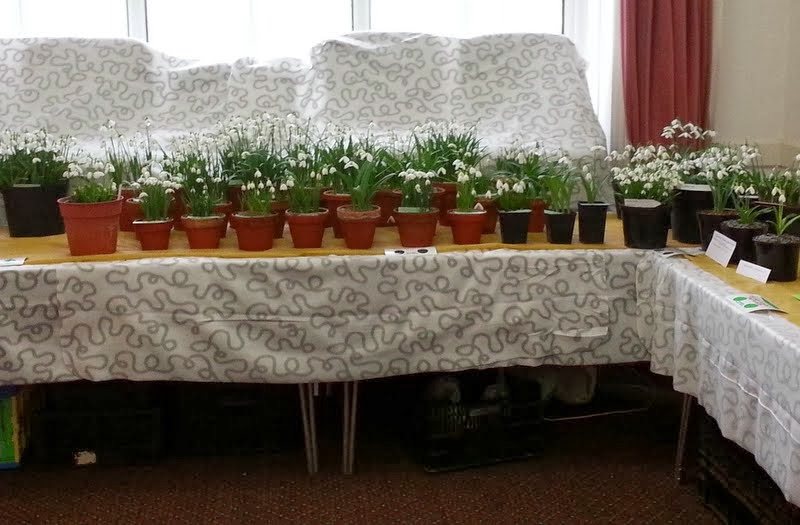
One couldn't help but be overwhelmed by the aroma from this bench. It was the first bench coming through the door. A Galanthophile's dream! Until that very moment, too me, a snowdrop was a snowdrop, was a snowdrop! It was a spring flowering bulb that produced a tiny white flower, with blotches of green on it's petals. I mean the snowdrop no disrespect believe me.  I could clearly see the different markings and shapes of all those named varieties many of you grow but until that very moment I just didn't get it!  It was a kind of eureka moment.


The sheer difference between the species and the varieties had been something that had escaped me until now.  Size, height, leaf and flower form - I truly had no idea!

Those white sheets covering the tables and used as a backdrop provided far too much of a glare to get decent pictures - I took hundreds to share with you all as I know many of you have a snowdrop thing!  The best of the bunch and it's not a terribly big bunch I'm afraid.
Galanthus Fred's Giant
Galanthus Brenda Troyle
Galanthus plicatus
To the rear Galanthus Lavinia
Galanthus Augustus
Galanthus Wasp
Labelled as Galanthus Rozella
 I can't find any other reference to it online
I did not expect to be so impressed with the special Snowdrops but had G. plicatus Diggory on my want list. I immediately fell for G. plicatus Augustus, sadly neither was available on either the trade or the members tables for sale.  I had more of a drawing towards the plicatus type of Snowdrop, I suspect it's because they look like sturdier plants.  Which one/ones did I buy?  I'm keeping you in suspense just a wee bit longer - I've a bit of a story to tell about my choice and I know you'll all want to read about it.   

It wasn't all about the Snowdrops - there was lots more to see.  Please join me for a wander around the room.

Primulas are a favourite here in my garden - they grow well here and no matter where I go I'm always attracted to them.  This show was perhaps a bit too early in the year to have a lavish display of Primula but those that were there were lovely healthy plants.


Primula on display
I like how these has been displayed - this I think, could easily be replicated in a larger trough and make a lovely display on a patio.  I've no doubt I'll give it a try sometime.

Primula allionii
A selection of wild collected specimens displayed
to show the natural variations in the plant
Cyclamen are easily recognised - in varying shades of pink and even more variable markings on their leaves, a very pretty display indeed.


Cyclamen display
I liked this delicate pink coloured one but I forgot to take a note of it's name and can't make it out on the label.

As we moved around the room, it was by this time getting a wee tad busier. It was getting harder to get up close and personal to admire the plants.  The Crocus display was vibrant to say the least.  It's not until you see them all grouped like this can you appreciate just how different the species are, just like the snowdrops.

Crocus display
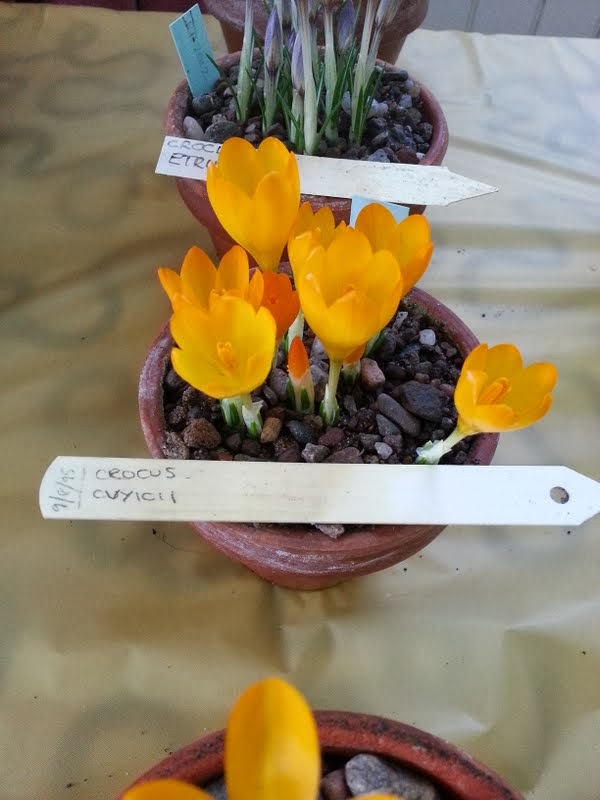
One of my favourites was Crocus cvijicii, a native of Serbia, Albania and Macedonia according to the Alpine Garden Society. 
Crocus cvijicii
and one of my not so favourites - Crocus angustifolius.  To me they look rather plastic and resembled those foil bows you buy at Christmas time.  Each to their own I suppose - beauty is in the eye and all that!

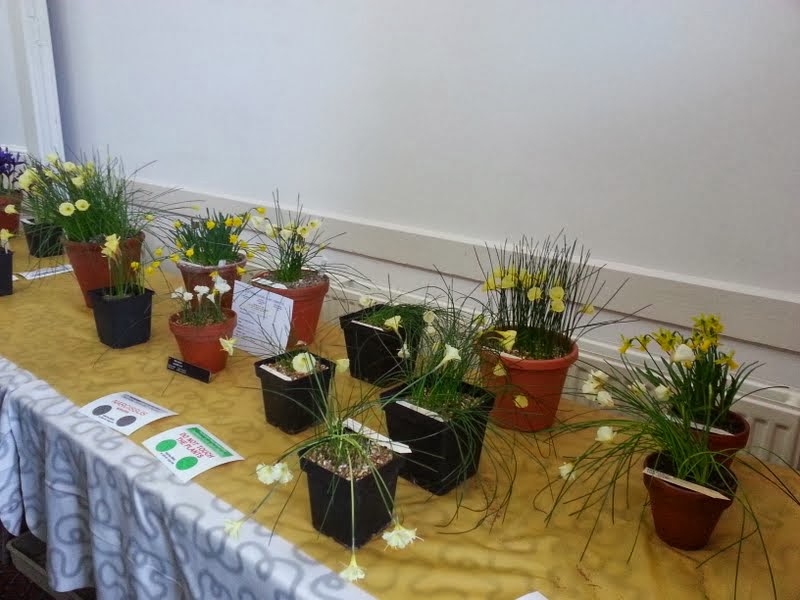
The Narcissus on display were not in their masses either.  In fact when I was taking pictures early in the day there was only 3 or 4 pots on display.  Luckily I popped back in at the end of the day.  Until a couple of years ago a daffodil would never have seen the light of day in my garden.  White and dwarf Narcissus  now grow in the garden as I have learned to appreciate their value in the spring garden.  These species Narcissus are little treasures - I haven't really done much research on these yet but think one or two would make a lovely addition to the miniature garden I grow in a trough.   
Narcissus display
I was particularly drawn to this Narcissus cantabricus - a white hooped petticoat daffodil, so called because of the characteristics of it's flower.  It's delicate and very pretty.

Another I like but didn't get it's name, of course if you know do tell.  The scent around this table was every bit as pleasant as the snowdrops.  I took a wee fit of sneezing soon after I bent down to take a closer sniff! 
Suggestions of ID of plant to the rear please?
No early bulb show would be complete without the Iris would they?  They were out in their masses on Bloom Day Posts this month and as many of us grow them, I thought you'd like to see more.

It was love at first sight - you could not fail to be bowled over by this beauty.  There is very little information out there on this particular Iris but according to the American Iris Society it is a cultivar of Iris histrioides, there after it all gets far too technical for my beginners brain.  If added a link here for the American Iris Society should you like more information.

Iris Reine Immaculee

Iris Reine Immaculee
close up
Iris Sheila Ann Germaney

Iris Pauline

Iris Display
The pot of Yellow flowering Iris in the middle was gorgeous - of course guess who forgot to get a close up and a note of it's name.  It could be I. danfordiae - if you know and can tell from this picture I'd be grateful.

A few individual plants that really caught my eye - as they do!

Eranthis schwefelglanz, the camera did not pick up just how apricot coloured these were.  Apparently the name schwefelglanz means sulphur gloss in German.  This would make a lovely change to the yellow ones we are used to.

Eranthis schwefelglanz
Another plant on my shopping today was a pink flowering Corydalis - I immediately fell for this little beauty.  I aleardy grow C. Beth Evans in the garden but wanted something a little different.  Sadly, the only Corydalis I could find was the yellow flowering variety or C. malkensis - which I also grow.  Corydalis shanginii is quite rare therefore I doubt I'll be sourcing those sometime soon! I love dark tips on the flowers.

Corydalis shanginii
This next plant was a complete new one on me - from a distance it actually looked like a wallflower - however as I got closer the resemblance got less and less!  I do hope I haven't hurt it's feelings!  I found information on the Alpine Garden Society website if you want to know more.   These are herbaceous members of the  Berberidaceae family and native to what was once the Soviet Central Asia area.

Gymnospermium albertii
Last and certainly not least  Ipheion dialystemon were beautiful.  It would however require an alpine house or cold frame if it were to survive here in my garden.

Ipheion dialystemon
Once we had finished oohing and aahing at the members plants - it was onwards and upwards!  There was just enough time to give the trade stands a first pass before the first talk commenced at 11am.

The talk, Make your own Narcissus (and snowdrops) by Anne Wright.  I was looking forward to this.  I had seen images of how to propagate from bulbs and read articles on the subject but just couldn't get my head around it.  Again, my fear of tiny little things always gets the better of me.  There will be more about the talk(s), what I learned and of course what came home with me in part 2.